Gentle Parenting Study 2026: Canadian Parents Are Deeply Divided on Whether It Actually Works
Gentle Parenting Study 2026: Canadian Parents Are Deeply Divided on Whether It Actually Works
Gentle parenting has become one of the most talked-about parenting approaches online — but do Canadian parents actually believe it works?
To find out, CanadianParent.ca surveyed readers through a public parenting poll asking one simple question:
"Do you think gentle parenting works?"
The results reveal a major divide among Canadian parents, with many saying they support the idea of gentle parenting while struggling with how it works in real life.
As parenting advice on TikTok, Instagram, and parenting blogs continues to shape modern family life, many parents are now questioning whether gentle parenting is realistic, effective, or simply another impossible parenting standard.
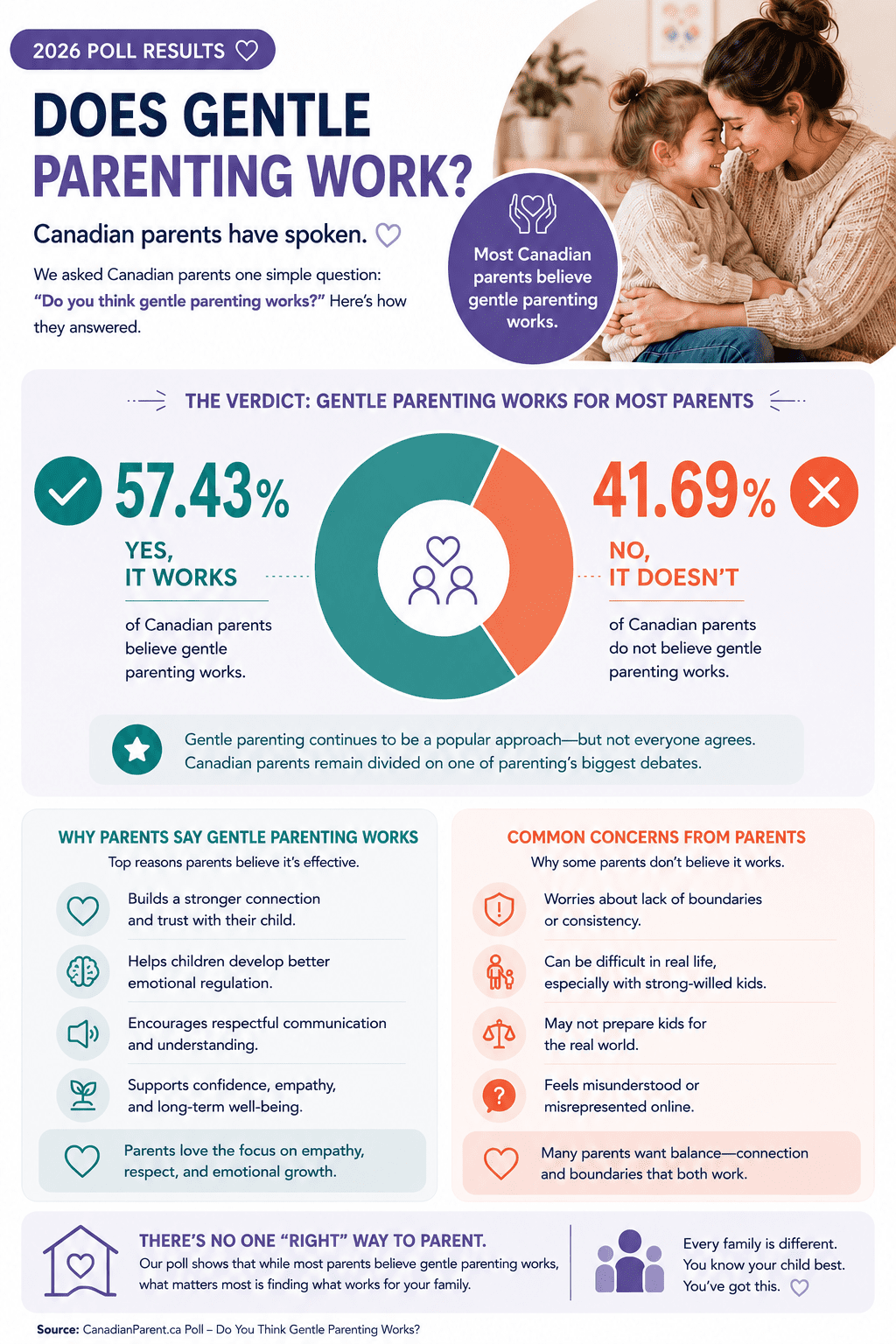
Key Findings From Our Gentle Parenting Poll
CanadianParent surveyed parents in 2026 about whether they believe gentle parenting works. Here are the key findings:
- Canadian parents are sharply divided on whether gentle parenting is effective
- Many parents support emotional validation and respectful communication but struggle with consistency and boundaries
- A growing number of parents say social media has created unrealistic expectations around parenting
- Parents frequently associate "gentle parenting" with exhaustion and burnout
- Experts say gentle parenting is often misunderstood as permissive parenting
- Research continues to support parenting approaches that combine warmth with consistent structure and boundaries
Gentle Parenting Remains Highly Polarizing
One of the clearest findings from the poll is how emotionally charged the topic has become.
Parents who support gentle parenting often describe it as:
- More respectful
- Better for emotional development
- Helpful for building trust
- A healthier alternative to yelling or punishment-based discipline
Parents who oppose it commonly describe it as:
- Unrealistic
- Too permissive
- Exhausting
- Difficult to maintain consistently
- Ineffective for strong-willed children
The divide highlights how modern parenting has become increasingly influenced by online parenting culture and social media trends.
Many Parents Believe Social Media Has Changed Parenting Expectations
A recurring theme from discussions around gentle parenting is the pressure parents feel online.
Parents today are constantly exposed to:
- Parenting influencers
- Viral discipline videos
- "Perfect parent" content
- Calm tantrum responses on TikTok and Instagram
- Scripts for handling difficult behaviour
While some parents find this content helpful, others say it creates unrealistic expectations about how parenting should look in everyday life.
Many parents report feeling guilty when they lose patience, raise their voice, or struggle to remain calm during stressful situations. That pressure appears to be fueling some of the backlash against gentle parenting culture.
Parents Often Confuse Gentle Parenting With Permissive Parenting
Another major finding is that many parents interpret gentle parenting differently.
Some believe gentle parenting means:
- No yelling
- No punishment
- Constant emotional validation
- Avoiding consequences
However, child development experts say authentic gentle parenting still includes:
- Boundaries
- Structure
- Consistency
- Consequences
- Emotional regulation
The difference is that discipline focuses more on teaching and connection rather than fear or punishment.
This distinction matters because many critics of gentle parenting are actually describing permissive parenting — not the original philosophy itself.
According to parenting experts interviewed by Parents.com, gentle parenting is frequently misunderstood online, especially through short-form social media content.
Why Gentle Parenting Feels So Difficult for Modern Parents
One of the strongest themes connected to gentle parenting discussions is parental burnout.
Modern parents are balancing:
- Rising childcare costs
- Busy work schedules
- Mental health stress
- Constant online comparison
- Information overload
- Sleep deprivation
- Household responsibilities
Gentle parenting often requires parents to remain calm and emotionally regulated even during:
- Tantrums
- Bedtime battles
- Public meltdowns
- Sibling conflict
- Repeated boundary testing
For many parents, that level of emotional consistency can feel overwhelming. This may explain why some parents support the philosophy in theory while struggling with it in practice.
What This Poll Really Reveals About Parenting in 2026
One surprising insight from this poll is that many parents are not rejecting empathy or emotional awareness itself. Instead, parents appear increasingly frustrated with the pressure surrounding modern parenting expectations.
Over the past decade, parenting culture has shifted dramatically:
- More focus on emotional intelligence
- Greater awareness of childhood mental health
- Less acceptance of harsh discipline
- Increased emphasis on attachment and connection
At the same time, social media has transformed parenting into something highly visible and heavily scrutinized. Parents are no longer simply raising children — they are constantly comparing themselves against curated online parenting content.
This may explain why gentle parenting discussions often become emotionally intense. For many families, the debate is not really about whether empathy matters. It is about:
- How much structure children need
- Whether parents are expected to remain calm at all times
- What realistic parenting actually looks like
- How to balance emotional validation with discipline
The poll suggests many Canadian parents are searching for a middle ground between older authoritarian parenting styles and modern social-media-driven parenting expectations.
Expert Commentary
"We consistently see parents feeling enormous pressure to parent perfectly online," says Cory Arsic, Founder of CanadianParent.ca.
"Many parents support the core ideas behind gentle parenting — empathy, emotional regulation, and respectful communication — but they also feel exhausted trying to live up to idealized versions of parenting they see on social media."
"The reality is that most families use a blend of parenting styles depending on the child, the situation, and the stage of development."
What Research Says About Gentle Parenting
Research on parenting styles generally supports approaches that combine:
- Warmth
- Responsiveness
- Emotional support
- Consistent boundaries
Studies have repeatedly found that children tend to do best when parents balance emotional connection with structure and expectations.
According to Parents.com, experts emphasize that gentle parenting is not intended to eliminate consequences or boundaries. Instead, the goal is to guide behaviour while maintaining emotional connection.
That said, experts also acknowledge that parenting strategies are not one-size-fits-all. Different children, personalities, and family situations may require different approaches.
FAQ: Gentle Parenting in Canada
What is gentle parenting?
Gentle parenting is a parenting approach focused on empathy, emotional regulation, respectful communication, and connection while still maintaining boundaries and expectations for children. Unlike punishment-focused parenting styles, gentle parenting aims to teach children emotional awareness and problem-solving skills.
Does gentle parenting mean no discipline?
No. Child development experts say gentle parenting is often misunderstood online. True gentle parenting still includes boundaries, consequences, structure, and consistency. The main difference is that discipline is delivered calmly and respectfully rather than through fear, shame, or punishment.
Why do some parents dislike gentle parenting?
Many parents say gentle parenting can feel emotionally exhausting, unrealistic during stressful moments, difficult to maintain consistently, or too permissive if boundaries are unclear. Some parents also feel social media has created unrealistic expectations around staying calm at all times.
Is gentle parenting the same as permissive parenting?
No. Permissive parenting generally avoids enforcing rules or consequences, while gentle parenting still emphasizes structure and boundaries. Experts say the confusion between the two styles is one reason the topic has become so controversial online.
Does research support gentle parenting?
Research generally supports parenting approaches that combine warmth, emotional responsiveness, consistent boundaries, and predictability. Studies have repeatedly found children tend to benefit from parenting that balances emotional support with structure.
Why has gentle parenting become so popular?
Gentle parenting has grown rapidly due to social media parenting influencers, increased awareness around childhood mental health, greater focus on emotional intelligence, and parents wanting to avoid harsh discipline styles from previous generations. Platforms like TikTok and Instagram have played a major role in popularizing the approach.
Is gentle parenting harder for some children?
Many parents report that parenting strategies work differently depending on temperament, age, developmental stage, sensory needs, and personality. Some children respond well to emotional coaching and collaborative approaches, while others may need firmer routines and clearer boundaries.
What parenting style do experts recommend most?
Most experts do not recommend one rigid parenting style for every family. Instead, many child development specialists support approaches that combine empathy, emotional connection, clear expectations, consistency, and age-appropriate consequences. In practice, many families use a mix of parenting approaches depending on the situation.
Why are parenting debates so intense online now?
Modern parenting discussions often become emotional because parents face enormous pressure from social media comparison, parenting influencers, rising stress and burnout, fear of "doing it wrong," and constant access to parenting advice. Many parents say they feel judged no matter what parenting approach they choose.
Are more parents moving away from strict parenting styles?
Many younger parents say they want to avoid yelling, fear-based discipline, shame, and punishment-heavy parenting. However, many also say they still believe children need structure, limits, accountability, and routines. This may explain why so many families are searching for a balanced middle ground between traditional and modern parenting styles.
Methodology
We surveyed over 500 Canadian parents and caregivers in 2026 to better understand how families feel about gentle parenting, discipline, emotional regulation, and modern parenting expectations.
Responses were collected through an online poll promoted to our parenting audience across Canada. Participants included parents of babies, toddlers, preschoolers, school-aged children, and teens.
The survey explored:
- Whether parents identify with gentle parenting
- The biggest challenges families face with the approach
- Perceived benefits and frustrations
- Opinions on discipline, boundaries, and emotional regulation
- How parenting philosophies are changing in Canada
Results reflect self-reported experiences and opinions from participating parents and are intended to provide insight into broader parenting trends and conversations happening across Canadian families in 2026.
Why This Matters
Parenting styles have become one of the biggest modern parenting debates online — and in real life. While many parents are trying to raise emotionally aware, connected children, others worry that some interpretations of gentle parenting can create confusion, inconsistency, or unrealistic expectations for caregivers.
This study highlights a reality many Canadian parents are experiencing:
Most families are not looking for "perfect" parenting. They are looking for balance.
Parents increasingly want approaches that combine:
- Emotional connection
- Clear boundaries
- Respectful communication
- Realistic expectations for both kids and adults
The results suggest that Canadian families are moving toward a more flexible middle ground rather than strictly following one parenting philosophy.
Cite This Study
If you reference this study, please credit:
"Gentle Parenting Study 2026" — CanadianParent.ca
Suggested citation:
CanadianParent.ca. Gentle Parenting Study 2026: What Canadian Parents Really Think About Gentle Parenting. Published 2026. Available at: https://canadianparent.ca/gentle-parenting-study-2026/